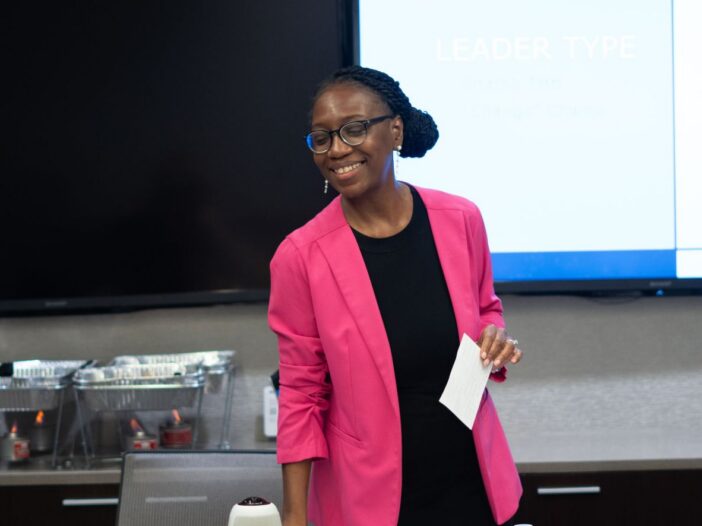
Michele Johnson is an executive coach with more than two decades of clinical experience as a Physician Assistant. She works with leaders in mission-driven organizations to help them perform at their highest level, drawing on her background in neuroscience, positive intelligence, and mind-body health. Our Director of Marketing and Communications, Erin McNulty, sat down with her for a conversation about her unique lens on executive coaching, what organizations should watch for in their leadership teams, and how coaching can be a stabilizing force during disruption.
Erin: I want to start with your clinical background, because I think it’s so central to how you coach. Can you tell us what you were seeing in your practice that eventually led you toward coaching?
Michele: If it were only my story, I might have missed the impact of what I see. I came across this statistic from the National Health Institute, that about 97% of the reasons people come into their doctor’s office are stress or stress-related illness. When I started this work back in 2018, that number was 77%. Think about that shift in just a few years.
I watched people come into my office at a breaking point. They’d been pushing through, meeting the deadline, staying on the path, and their bodies were quietly keeping score. They’d been ignoring a health concern because they had to. They had to get to a certain point where they felt like they could elevate in their work, because that’s the path.
And as someone who was a high achiever, who was always trying to grow and do something great — yes, I experienced that moment for myself. I had 20 years of chronic pain. Sometimes falling asleep on the road. Sometimes my legs didn’t work and I had to crawl to the bathroom in the morning. I am now pain-free for five years.
“It’s not just about the strategy. It’s about changing the identity — or the way we thought we should be walking through the world.”
Erin: That’s a powerful frame, and it’s different from how most people think about leadership coaching. What were you hoping to do differently for people than what the traditional route offered?
Michele: Healthcare is actually a leadership system, modeled after many of the corporate structures we have. There’s an administrative portion, a clinician portion, and the patient who enters the system. What I saw in a lot of healthcare leaders is that about 75% of them are burnt out right now. And when we are burnt out, clinicians can get into a routine of how they see people, without seeing the individual in front of them.
I practiced in a clinic where I had three people booked at the top of the hour. Three people. That means 15-minute slots that are filled with three people. And that lends itself to not getting to what’s actually going on with someone. The shift to coaching allowed for deeper conversations. Starting with physicians having actual team meetings that shifted the way they looked at their own health and their own ability to show up with a patient in front of them.
And then talking with leaders across different dynamics, diverse leaders who were saying they felt invisible in their workplace, that their voice wasn’t being heard, that they were always trying to figure out: how do I show up in a way that’s aware of the value I bring to the table, and be able to speak into the listening of my peers? Coaching brought that dynamic forward.
Erin: What does it look like inside an organization when leaders are engaged in coaching? How do you start to see that shift show up?
Michele: It’s not always that we’ve laid this big foundation and framework, going through the steps and motions. It’s not just the nuts and bolts of the conversation. There is a dynamic shift even in body language. I watch them rest in their posture. I watch them light up in their eyes as they describe an interaction they’ve been dreading for months that they finally had the words for. They had the conversation, and it went so much better than they thought it would.
Or I’ll hear: ‘I instituted this one boundary. I will schedule emails and not check them after work. That one boundary has shifted my whole home life. I show up to work different.’
We all fall into these ‘have to’s,’ right? I have to do this. I have to get this part done. I have to work a couple hours on the weekend. And then when you set a boundary and you watch how much easier it becomes to actually do the things in your role. In my study of neuroscience and positive intelligence and mind-body therapies, executive coaching has been taken to the next level because people didn’t realize it’s not just about the strategy. It’s about changing the identity and the way we thought we should be walking through the world.
That light bulb that comes on. I don’t have to be what I thought I had to be. I get to be exactly who I’ve designed this next level to be.
Erin: From your clinical eye, what patterns do you see in leadership teams that signal an organization could benefit from coaching?
Michele: We tend to fall into one of a few categories in our approach to leading our teams. Either we are the folks who decide: I see a deficit and I’m going to insert myself to take care of it. We call those folks the doers. Many of them have spent their whole career learning how to do a thing, and when they see a deficit, they want to help. But unfortunately, that doesn’t allow their teammates to grow to the top of their potential. It doesn’t allow for rest for the leader. It doesn’t allow for the team to grow as a unit.
I had someone who was trying to do everything for her team. And it landed with her trying to do nice things, trying to increase morale, and things just continuing to escalate for her.
The other side of the coin is I’ve seen leaders who try to micromanage everything and not allow for any creativity, any diversity of opinion or action. Because I don’t necessarily do it like you, and you don’t necessarily do it like me, but we may both contribute to something that could be uniquely beautiful in moving forward.
Erin: What do you find most meaningful about working with leaders in social impact, specifically?
Michele: It is such an honor to work with brilliant people who are walking in purpose. Some of the experiences I’ve had with leaders who have tapped into the CSR way of coaching: there is structure for those of us who need structure, and there’s also room for our humanity in our role.
What I’ve learned to appreciate about the leaders I’ve had exposure to in coaching with CSR is that no matter what, we are human. We have that shared experience. They’re so eager to learn, grow, and be different, and they put in the work to do so. That has been such a pleasure to watch.
To hear someone say, ‘These sessions have made a difference in how I’m approaching my life, my family, my work.’ It’s humbling and absolutely amazing.
“The people who care the most need a place to have safety and a place to explore who they’re becoming.”
Erin: For organizations weighing whether to invest in coaching for their leadership teams, what would you want them to understand about the value?
Michele: Think about it this way. When we offer health insurance or dental insurance, there is this gratitude for being able to have access to something that would be so much more expensive on our own. If I had not been exposed to coaching, I would not be able to stand upright and show up in presence in the rooms I’m now able to show up in, and make the difference I’m making, if it had not been for someone investing in me.
So when I think about the benefits we offer, medical, dental, hearing, I think about coaching in that same way. It is a benefit. It is a culture that we create. If our leaders understand that they need coaching to excel to their highest potential, of course they want to share that with their teams. Because what does coaching do? It takes you from where you are to where you want to be.
So when things come on like rapid change, AI, a whole upheaval in the way we do things, who will be ready? The people who have had the benefit of coaching. Of learning how to move through transition and rapid change. How to keep their own awareness and emotional intelligence. How to actually show up in presence with their teams and lead effectively.
Erin: Last question. For an organization that’s not sure this is the right moment to invest in coaching for their leadership team, what would you want them to hear?
Michele: Being on the fence is always a difficult place to be. What I would say is: if your people are feeling overwhelmed, if you’re feeling overworked, if you’re out of time, one of the things I’ve seen coaching do is create time. Create boundaries, create time blocks, create different ways of working and thinking about identity.
You could always try it out. It’s not something you need to commit to long term. But get clear on what you need to happen, find the right coach, and just try. I guarantee the team will be different on the other side of it. Because coaching works.
About Michele Johnson
Michele Johnson is a certified executive coach and Physician Assistant with over two decades of clinical experience. She partners with leaders in social impact and mission-driven organizations to build sustainable performance, reclaim their voice, and lead with authentic authority. She is part of the CSR extended network of consultants.
This interview has been lightly edited for clarity and length.